Casino Route Engineering for AP Slot Scouting
Finding playable states is only half the job. A strong route turns limited casino-floor time into consistent coverage, timely revisits and better decisions.
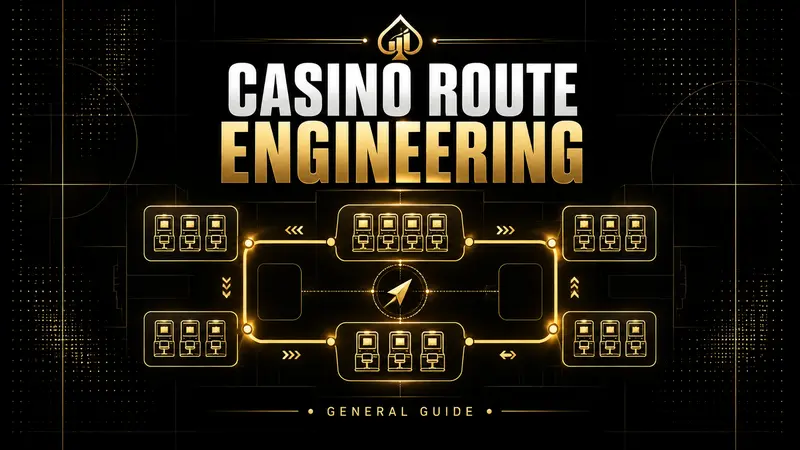
From scouting skill to scouting system
The beginner scouting process explains how to inspect an individual machine. Route engineering addresses the next problem: deciding which parts of a casino to inspect, in what order, how often to return and whether the time invested is producing enough opportunities.
A route should be repeatable without becoming rigid. The best sequence depends on machine density, walking time, player traffic, feature turnover and the quality of the states historically found.
Map banks, not individual seats
Begin with zones or banks that can be recognized quickly. Record the casino section, nearby landmark, machine family, number of units and whether progress is individual, shared or denomination-specific. A bank-level map is easier to maintain when machines move or seats are rearranged.
Do not record sensitive personal information about players. The purpose is to understand the floor layout and machine states, not to track individuals.
Assign every stop a priority
Not every bank deserves equal attention. A practical priority score can consider:
- Opportunity frequency: how often a potentially playable state appears.
- Observation speed: whether the relevant state can be checked in seconds.
- Average value: the estimated value of qualified opportunities—not the largest possible jackpot.
- Required exposure: the likely cost and volatility once a state qualifies.
- Competition: how often the bank is occupied or checked by others.
- Travel cost: walking time and detours from the main route.
A fast, moderately valuable bank along the natural path may deserve more frequent checks than a theoretically stronger bank requiring a long detour.
Design a core loop and optional branches
Build a core loop containing the highest-priority, fastest-to-read banks. Add optional branches for areas worth checking only when nearby, unusually quiet or showing higher player turnover.
This structure prevents one low-probability stop from consuming the entire session. It also makes routes easier to shorten when time is limited without dropping the most productive coverage.
Use revisit intervals deliberately
A revisit is valuable only when the state may have changed. Consider player traffic, typical play duration, bank occupancy and whether the feature can progress across multiple games or denominations. Busy banks may justify shorter intervals; slow sections may need only one inspection per visit.
Avoid hovering or pressuring seated players. Continue the route and return later. Efficient scouting depends on discretion and normal casino etiquette.
Separate inspection time from play time
Track how long the route itself takes before including time spent playing. Otherwise, a profitable result can hide an inefficient search process. Useful measures include:
- Complete route time
- Number of meaningful states inspected
- Qualified opportunities found
- Estimated EV found per route
- Actual play time generated
- Net result and estimated EV per total hour
These figures need many sessions before they become informative. A single large win can distort short samples.
Record changes without over-documenting
Use short, consistent notes: date, time window, route duration, closed or moved banks, qualified opportunities and major uncertainties. Photographing machines may violate casino policy, and extensive note-taking can be impractical. Follow property rules and keep the system simple enough to use every time.
Review routes by time window
The same casino can behave differently on weekday mornings, weekend evenings and event nights. Compare like with like. A quiet route may offer faster access but less state turnover; a busy route may create more abandoned progress but also more competition.
Change a route only after patterns emerge. Do not rewrite the plan because one trip was unusually good or bad.
Know when a casino or bank is not worth the stop
Remove or downgrade stops that repeatedly consume time without producing useful observations, require unacceptable wagers, stay occupied, or contain configurations that do not match your research. Time already invested is not a reason to keep an unproductive branch.
A simple route-review framework
- Did the core loop cover the highest-priority banks?
- Which detours produced useful information or opportunities?
- Were revisit intervals long enough for states to change?
- How much total time was scouting versus playing?
- Which route assumptions remain unverified?
- What single adjustment should be tested next time?
Turn the route into a measurable operating system
Members can combine machine-specific entry research with structured route notes, configuration checks and supported evaluation tools.
Frequently asked questions
How many casinos should be included in one route?
Only as many as can be covered without travel time overwhelming the value of the observations. Start with one property, measure it, and add another only when the combined route remains efficient.
Should every AP-capable bank be checked?
No. Prioritize banks with relevant configurations, reasonable inspection time and a realistic chance of producing opportunities suited to your bankroll.
How often should I revisit a bank?
There is no universal interval. Use observed traffic and state turnover, while avoiding hovering around active players.
Is profit per route the best metric?
Not by itself. Short-term profit is noisy. Also track time, qualified opportunities, estimated value and whether your process was followed.