Variance, Bankroll and Risk of Ruin in AP Slots
A favorable estimate does not guarantee a favorable result. Bankroll decisions must account for the size, frequency and timing of possible losses.
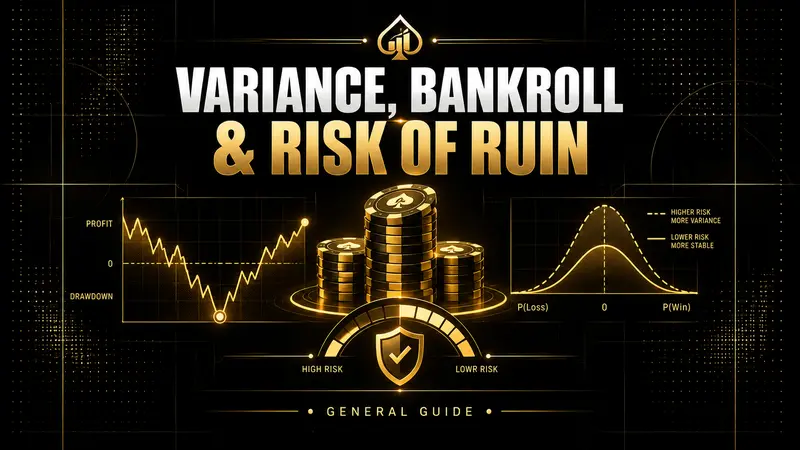
Positive EV and acceptable risk are different questions
Expected value asks whether the probability-weighted return may exceed the expected cost. Bankroll analysis asks whether you can survive the range of outcomes long enough—and whether taking that risk makes sense for you.
An opportunity can be estimated as positive EV and still be unsuitable because its required wager, possible drawdown, uncertainty or concentration is too large.
What variance means in practice
Variance describes how widely results can spread around their average. Two opportunities may have the same estimated EV but very different paths:
- One may return small amounts frequently and stay relatively close to expectation.
- Another may lose most attempts and depend on an infrequent large result.
The second opportunity is not automatically worse, but it can require more capital and greater tolerance for drawdowns.
Think in complete-opportunity exposure
Cost per spin is not the complete risk measure. Estimate how much may be required to finish the opportunity under unfavorable but plausible conditions. Include the qualifying wager, possible length of play, feature resets, linked competition and any point where the original assumptions stop applying.
Maximum theoretical loss may be impossible to calculate for an open-ended feature. In that case, use explicit stop conditions and label the remaining uncertainty rather than treating an average cost as a limit.
Bankroll is not the same as available cash
A gambling bankroll should be money deliberately separated from rent, bills, taxes, debt payments, emergency savings and other essential obligations. Access to additional cash or credit does not increase the quality of an opportunity.
Borrowing, chasing losses or moving essential money into a session is not bankroll management. It is a reason to stop.
What risk of ruin actually describes
Risk of ruin is the chance that a bankroll reaches a failure point before the underlying advantage has time to emerge. That failure point may be zero, but it can also be a predefined minimum below which you will no longer play.
A credible risk-of-ruin estimate needs more than EV. It requires assumptions about outcome distribution, variance, wager size, number of opportunities and whether future situations are comparable. If those inputs are unknown, a precise percentage would create false confidence.
The inputs that matter
- Starting bankroll: capital allocated exclusively to play.
- Average edge: estimated EV relative to the expected cost.
- Outcome distribution: the range and probability of possible results.
- Opportunity size: the amount exposed to one decision or cycle.
- Frequency: how often comparable opportunities actually occur.
- Correlation: whether several plays depend on the same assumptions or jackpot structure.
- Model uncertainty: how confident you are that the estimated inputs match the exact configuration.
Why percentage edge alone can mislead
A high estimated percentage return on a small, volatile sample is not automatically preferable to a smaller edge that can be repeated more often with controlled exposure. Compare absolute EV, expected time, likely drawdown and the reliability of the inputs.
Likewise, a large jackpot can dominate the mathematical average while contributing little to most individual sessions. The average may be valid without resembling a typical result.
Use bankroll tiers instead of one universal limit
A practical framework can divide opportunities into tiers based on estimated exposure and uncertainty:
- Core opportunities: lower exposure, repeatable and supported by stronger evidence.
- Selective opportunities: larger or more volatile plays accepted only when the state is unusually strong.
- Pass category: situations whose exposure, uncertainty or required wager exceeds the plan.
The thresholds must be personal and set before play. They are risk controls, not claims that a particular bankroll guarantees success.
Model drawdowns, not just average profit
Ask what a sequence of five, ten or twenty unsuccessful opportunities would do to the bankroll. This is a scenario test—not a prediction. If an ordinary losing sequence would force you to stop, lower the exposure or pass.
Track peak bankroll, current bankroll and drawdown from the peak. Drawdown shows how much capacity has been lost during a downswing and helps prevent the starting balance from becoming the only reference point.
Recalculate when the bankroll changes
After a meaningful drawdown, the same wager represents a larger share of the remaining bankroll. After a win, increasing stakes automatically can expose the entire gain to higher variance. Reassess tiers at scheduled intervals rather than reacting emotionally after every result.
Protect the model from false precision
Risk calculations are only as reliable as their inputs. Use ranges when probabilities, feature values or completion costs are uncertain. Test conservative assumptions. If a small change turns a play from acceptable to unacceptable, the correct conclusion may be that the decision is fragile.
Evaluate value and survivability together
Members can continue with supported machine research, selected calculators, configuration notes and deeper evaluation frameworks while treating every result as an estimate—not a guarantee.
Frequently asked questions
Can a positive-EV strategy go broke?
Yes. Limited capital, high variance, oversized wagers, inaccurate assumptions or too few opportunities can exhaust a bankroll despite a favorable mathematical estimate.
What is a safe risk-of-ruin percentage?
There is no universal safe level. The acceptable threshold depends on personal finances and goals, and uncertain slot inputs may not support a reliable percentage at all.
Does doubling the bankroll cut risk in half?
Not necessarily. The relationship depends on edge, variance, wager size and outcome distribution. It should not be assumed to be linear.
Should I increase stakes after winning?
Only after a planned review shows that the larger exposure still fits the bankroll and research. A recent win does not make a higher wager safer.