Who Owns the Progress? Shared, Local and Player-Specific Slot States
Before assigning value to visible progress, determine where that progress actually lives: one game, one denomination, one cabinet, a linked system—or, in some designs, a player session.
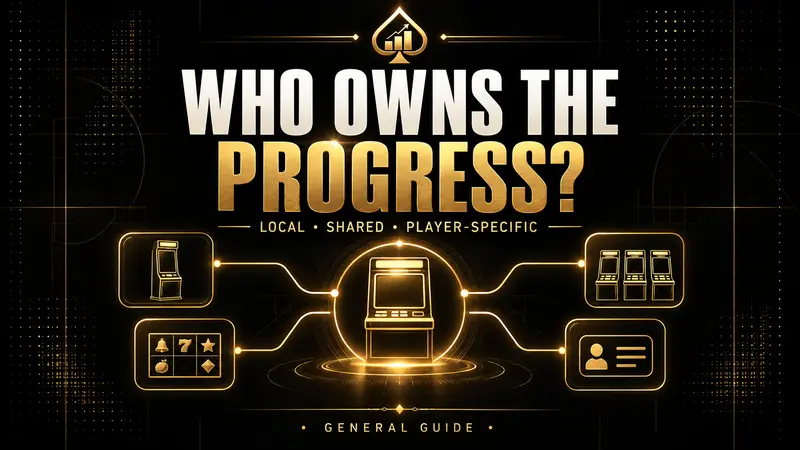
A meter, collector or jackpot can remain visible after a player leaves. But before treating that progress as meaningful, you need to know what it belongs to.
The state may belong to one game, one denomination, the entire cabinet, a linked group of machines or, in some systems, a player session. This is the difference between seeing progress and understanding the progress.
Persistence and ownership are different
Persistence means that information from earlier play remains visible or relevant later. Ownership describes where that information is stored and when it applies.
For example, a collector may remain on one cabinet but show a different value after switching denomination. A jackpot may be shared across several machines while a separate bonus meter remains local. A player card may display account information without storing the game's progress.
If you do not know which part of the system owns the state, you may read the wrong meter or apply information from the wrong configuration.
Where can the progress belong?
One game
On a multi-game cabinet, each title may keep its own progress. Switching games can reveal a different meter, while returning to the original game may restore the earlier state.
One denomination or wager setting
Progress may be separate for different denominations or bet configurations. A meter can also remain visible while only certain wagers qualify for its award. State ownership and wager eligibility must be checked separately.
The cabinet
Some progress may belong to the physical machine and remain available across games or settings on that cabinet. Similar artwork alone does not prove that the underlying state is shared.
A linked group of machines
Progressive jackpots are often linked, but that does not mean every visible feature is shared. A common jackpot can exist above collectors or bonus states that remain local to each machine.
A player or session
Some systems can save information for an identified player or active session. However, the presence of a player card does not prove that the base game's progress follows the player.
How to check the state
1. Read the machine information
Check the help screen, paytable and displayed rules for language about qualifying wagers, linked jackpots, saved progress and resets.
2. Change one setting at a time
If possible, compare one variable—such as the game, denomination or cabinet—while keeping everything else the same. Changing several things at once makes the result difficult to interpret.
3. Look for repeatable behavior
One observation can be misleading. Screen refreshes, another player's activity or a different configuration may explain what you saw. Repeat the comparison before treating it as established.
Common mistakes
- Assuming progress transfers between games because they share a cabinet
- Reading a meter from the wrong denomination
- Believing a linked jackpot makes every feature shared
- Assuming a player card stores the game's progress
- Comparing machines that look alike but use different configurations
State ownership does not automatically create an advantage. It tells you which information belongs in the evaluation. Expected value still depends on the mechanic, wager, cost and potential feature value.
A simple rule
If you cannot explain what owns the progress, treat the state as unverified.
Observe first. Check the rules. Compare one setting at a time. Only then decide whether the visible state belongs in your evaluation.
Related guides
- What Is a Persistent State?
- Perceived Persistence
- How to Read a Slot Machine Help Screen and Paytable
- Bet Level and Denomination
- AP Slot Scouting Checklist
Apply the idea in the casino
The Patreon guide adds a practical comparison routine, a compact observation checklist and examples of how shared and local states affect a play-or-pass decision.
Frequently asked questions
Does a player card mean the slot progress follows me?
No. A card can track loyalty activity, account information or promotions without storing the base game's persistent feature. Player-specific state requires separate evidence.
If machines share a progressive, do they share all progress?
Not necessarily. A progressive amount can be linked while collectors, bonus states or other displays remain local to each game or cabinet.
Can changing denomination reset a persistent state?
It can, but behavior varies. The displayed state may be denomination-specific, shared or merely subject to different qualifying rules. Verify the exact configuration.
Does persistent progress automatically have value?
No. Persistence and ownership tell you how information is retained. Expected value still depends on the mechanic, qualifying wager, cost, feature value, uncertainty and other variables.