Slot Advantage Play Myths: Due Machines, Full Pots and Guaranteed Wins
Advantage play begins with observable information—not predictions based on streaks, excitement, or appearance. These common myths explain where disciplined evaluation ends and guessing begins.
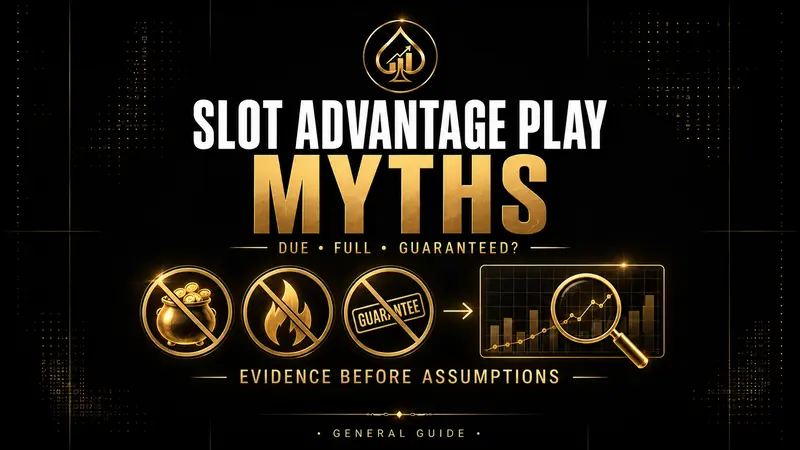
Slot advantage play is often misunderstood in two opposite ways. Some players assume every impressive display is an opportunity. Others assume the entire subject is just another version of “the machine is due.”
Neither view is accurate. A legitimate AP evaluation asks whether an observable state changes the expected value of future play. It does not claim certainty, eliminate variance, or turn ordinary losing streaks into evidence.
Myth 1: A machine is due after a long losing streak
A sequence of losing spins does not normally make the next independent spin more likely to win. The machine does not owe a player a recovery because recent results were poor.
This is the gambler's fallacy: treating past independent outcomes as if they create a debt that future outcomes must repay.
A losing history becomes relevant only when the game explicitly tracks a state that affects future play. The important evidence is the documented state—not the fact that someone has been losing.
Myth 2: A machine that recently paid is now cold
The reverse belief is also unreliable. A large win does not automatically make the next spin worse, and a machine can produce wins close together.
A jackpot or feature may reset a persistent meter, collector, or progressive. That reset can change the state, but it is the reset itself that matters—not a general rule that the machine became cold because it paid.
Myth 3: A full pot must be ready to pop
Growing pots, piles of coins, flames, characters, and other visual buildup are designed to communicate excitement. Some displays correspond to meaningful progress. Others are primarily entertainment or provide only incomplete information.
The correct questions are:
- Does the display retain its state?
- Does a more advanced display change future probability or value?
- Can that relationship be verified?
- Does the current wager qualify?
Until those questions are answered, “full” is a description of appearance—not a play signal. See Perceived Persistence for a deeper explanation.
Myth 4: Every persistent state creates an advantage
A state can genuinely persist without being valuable enough to justify playing. Persistence tells you that information carries forward; it does not automatically answer the expected-value question.
A small amount of stored progress may be real but economically insignificant. Wager cost, feature value, remaining work, probability, denomination, and variance still matter.
The What Is a Persistent State? guide explains the concept, while Expected Value and Why It Matters explains why value must be compared with cost.
Myth 5: A high meter automatically means positive EV
A high meter is more advanced than the same meter at a lower value, but that does not establish a universal entry point. Two machines showing similar percentages can have different wagers, contribution rates, jackpot values, base returns, and feature economics.
For a must-hit-by display, the ceiling provides a meaningful boundary. It still does not reveal the exact number of spins remaining or guarantee that the current state is profitable. Use How to Read a Must-Hit-By Slot Machine Meter to separate the visible facts from the missing calculation.
Myth 6: Max bet is always the correct bet
Some jackpots or features require a particular wager. Others do not. “Always bet max” is not a substitute for reading the game rules.
A higher wager can increase cost faster than it increases relevant value. The qualifying bet must be confirmed on the exact game and configuration. The Bet Level and Denomination guide covers this decision in more detail.
Myth 7: The same title works identically everywhere
Recognizing a familiar title is useful, but it is not enough. Theme variants, denominations, jackpot setups, linked configurations, and enabled features can differ.
Before transferring any assumption, verify the exact title, current wager, paytable, jackpot conditions, and visible rules. The companion guide How to Read a Slot Machine Help Screen and Paytable provides a repeatable verification process.
Myth 8: A strategy guarantees a win
No strategy, machine state, or calculator can guarantee a winning session. Expected value describes an average across repeated outcomes, while any individual result can fall far above or below that average.
A favorable decision can lose. An unfavorable decision can win. Short-term results do not change the quality of the decision that existed before the outcome was known.
This is why bankroll discipline and loss limits remain important even when the underlying evaluation is strong.
Myth 9: One win proves a theory
A single successful result cannot validate a trigger theory, entry point, or visual tell. Slots are volatile, and weak decisions can occasionally produce large wins.
Evidence should come from documented rules, repeatable observation, credible research, and—where possible—sufficient data. Results should be recorded honestly, including losing sessions. The AP Results Tracking guide explains why complete records are more useful than memorable stories.
Myth 10: A loss proves advantage play does not work
One loss does not disprove a positive expectation any more than one win proves it. The correct question is whether the information and assumptions used before play were sound.
Review:
- Was the state identified correctly?
- Was the exact configuration confirmed?
- Did the wager qualify?
- Were costs or competition overlooked?
- Was uncertainty treated honestly?
That review improves the process without rewriting the decision based solely on its outcome.
Myth 11: Every AP claim found online is reliable
Videos, forum posts, and social-media comments can provide useful leads, but a confident statement is not the same as verified information. Rules change, configurations differ, and observations can be incomplete.
When evaluating a claim, ask what supports it:
- Is the feature documented on the machine?
- Does the claim identify the exact version and wager?
- Does it distinguish observation from calculation?
- Does it acknowledge uncertainty and variance?
- Can it be compared with other reliable evidence?
What legitimate advantage-play reasoning looks like
A disciplined evaluation usually follows a simple sequence:
- Observe a state that may carry information.
- Verify the mechanic and qualifying wager.
- Measure the current state accurately.
- Estimate value, cost, uncertainty, and variance.
- Compare the state with predefined criteria.
- Pass when the evidence is incomplete or the opportunity is not strong enough.
This is consistent with the process described in How APWebsite Evaluates Advantage Play and the free AP Slot Scouting Checklist.
Machine examples
Phoenix Link demonstrates why a bounded counter can be meaningful without guaranteeing a profitable or immediate result. Buffalo Link shows why multiple visible variables must be evaluated together rather than reduced to “the machine looks ready.”
Scarab provides a different kind of persistent-state example, reinforcing why one universal rule cannot be applied across unrelated mechanics.
The key takeaway
Advantage play is not the belief that a machine is due. It is the disciplined use of verified information—combined with the willingness to pass when the evidence is insufficient.
The goal is not to predict the next spin. It is to make a better decision with the information available while accepting that gambling outcomes remain uncertain and volatile.
Related guides
- Perceived Persistence
- What Is a Persistent State?
- Expected Value and Why It Matters
- How to Read a Slot Machine Help Screen and Paytable
- How to Read a Must-Hit-By Slot Machine Meter
- Beginner Mistakes and Bankroll
- Phoenix Link, Buffalo Link, and Scarab
The public guide corrects the myths. Detailed decisions stay member-only.
APWebsite members can access supported machine-specific entry criteria, calculators, configuration notes, and deeper play/pass frameworks. These tools improve evaluation; they do not guarantee any gambling result.
Frequently asked questions
Are slot machines ever due to hit?
A losing streak alone does not make an independent next spin more likely to win. A documented persistent state can matter, but that is different from saying a machine is due.
Does a full pot mean a bonus is close?
Not necessarily. Some visuals correspond to meaningful progress; others may be cosmetic or incomplete. The relationship must be verified for the exact game.
Does a high meter guarantee positive expected value?
No. Wager cost, contribution behavior, feature value, configuration, variance, and other factors still determine whether the state is attractive.
Can advantage play guarantee profit?
No. Even a favorable expected-value decision can lose in an individual session. Gambling remains uncertain and financially risky.
Should I always play the maximum bet?
No universal rule applies. Use the wager that qualifies for the feature being evaluated and compare its cost with the relevant value.